

|
Getting your Trinity Audio player ready...
|

In 2019, there was an interesting dispute between the National Transportation Safety Board (NTSB) and the National Association of City Transportation Officials (NACTO). While looking at the latest data from the National Highway Traffic Safety Administration (NHTSA), NTSB became concerned that traffic deaths are still rising. So the NTSB – people who usually research crashes around planes, trains, and automobiles – recommended that all 50 states implement bicycle helmet laws. Though injury and fatality numbers increased for all modes, NTSB’s recommendation did not include helmets for drivers or pedestrians and only recommended mandatory helmets for cyclists. Either NTSB does not like drivers and pedestrians as much, or is really, really concerned about cyclists.
NTSB has not cared much about bicycle safety since 1972, so the National Association of City Transportation Officials (NACTO) first had to catch them up on the science: “Experience has shown that while bike helmets can be protective, bike helmet laws are not. NACTO strongly urges NTSB to remove the recommendation that states adopt mandatory helmet laws and work with their federal and state partners to enshrine the remainder of this critical, timely, and well-researched report into practice.”
To understand this disagreement between NTSB, NACTO, and NHTSA, we can look to other countries that have extensively researched this topic. For this topic, we best enter The Commonwealth of Nations or at least four of their countries: New Zealand, Australia, the U.K., and Canada. Since they all speak English and all have very similar ‘cultures,’ there is a lot of comparable research available. Australia and New Zealand were the first countries to introduce helmet laws in the early 1990s. Canada has some regions with similar policies; in the U.S. and U.K., there is a lot of bike helmet bullying going on. Researchers have been able to draw many conclusions from their results ever since, and that’s why not too many countries have these laws. Cycling U.K. put together a great summary, and so did various other researchers.
Old British Bicycle Helmet Standard (BS6863, 1987)
The old standards for cycle helmets said: “Cycling helmets are intended to give protection in the kind of accident in which the rider falls onto the road without other vehicles being involved.”
This implies that helmets are of little value when the cyclist collides with a motor vehicle.
EU Standard (EN 1078)
Bicycle helmets are a weird compromise between strength and weight. Protecting against hitting a flat surface or hitting a curb requires different designs. The old British Standard was the strong one; subsequent standards have been progressively weakened due to lobbying by the manufacturers themselves.
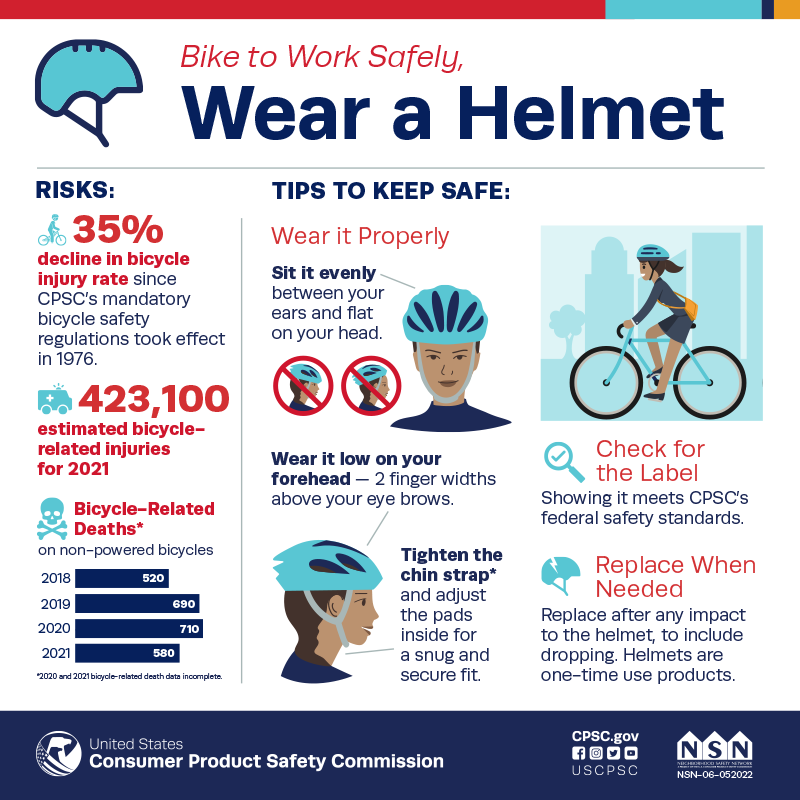
And even with standards, there is always a very good chance you own the wrong one or use it for too long already.
Safety Statistics
Looking at the statistics behind Traumatic Brain Injuries (TBI), it turns out cycling is far from being the most dangerous activity. Most TBI-related cases happen to car drivers, passengers and people hit by motorists. People are just tripping and falling everywhere. Apparently, people are falling out of bed and injuring their brains. A lot of TBI cases have to do with guns.
It turns out that if Safety were the big concern behind helmet laws, helmet laws would have to include driving, walking, and everyone living in a home with a gun. Especially in the U.S., those activities seem more dangerous than cycling.
Commonwealth Research Facts:
- U.K.: “Pedestrians and drivers account for five and four times the number of fatal head injuries as cyclists.”
- Australia: “proportion of head injuries requiring hospitalization was about the same for cyclists (27.4%) as for drivers (26%) and less than pedestrians (33.3%)”
- U.K.: “cycling accounted for 10% of child traumatic brain injury (TBI) admissions, but pedestrians accounted for 36%, while falls accounted for 24%”
- Australia: “cycling without a helmet carried only slightly more risk of death or serious injury per hour than driving”
- Germany: “report from 2009 found that the rate of serious head injuries amongst cyclists, pedestrians and car occupants is similar”
- Canada: “Bike helmet laws got more people wearing them, but did little to reduce the rate of serious, hospital-worthy injury. In fact, helmet use had almost no effect at all”
- Denmark: “compared with pedestrian and car occupant injuries, cycling injuries result in the shortest hospital stays and are least likely to be serious”
Do Sports Helmets work?
There is even better science available about helmet wearing contact sports. It turns out that helmets don’t help much there, either. The results are, in fact, so devastating that the Mercury News just recently called for the ban of tackle football. The link between Parkinson’s Disease and boxing was already established. But football players also have a 61% greater risk. Playing football increases the chance of CTE by 15% every year.
And other sports, like baseball, rugby, lacrosse, soccer, and wrestling, aren’t much safer either. If helmets made a difference, it certainly does not show in high school sports or college. And professional sports are even worse; out of 111 NFL brains, 110 were found to have CTE that led to aggression, depression, and suicide.
All these guys were wearing helmets of higher quality than cycling helmets.
The Law of Unintended Consequences
Colin Clarke (Cycling U.K.) asked, “Why does the Netherlands, with hardly any cycle helmet wearing have a fatality rate of 8 per billion kms cycled, the U.K. with 21 and the USA with 49?” He concluded that “The emphasis on helmets is unscientific and, more importantly, damages cycling and blocks the kind of cycling policy and infrastructure in successful cycling cities, e.g. Freiburg, Delft, Lund, Copenhagen or Muenster.” Colin Clarke refers to the fact, that bicycle helmet laws led to a 36% drop in people cycling, leading to fewer injuries overall. However, looking deeper into the data led to the conclusion that helmeted people’s injuries actually increased.
Researchers from various countries kept coming to similar conclusions. Professor Piet de Jong, Dr. Kay Teschke,Dr. Harry Hutter, Dr. Ian Walker, and many others uncovered the following facts:
- Experienced cyclists felt a false sense of security, rode faster and harder and gained more injuries.
- Bicycle helmet laws suppressed bicycle usage in NZL, AUS, and CAN by up to 60%.
- Female riders, children, seniors, and minorities were turned away by mandatory helmet wearing
Commonwealth Research Facts:
- Canada: “In some instances, helmeted cyclists ride faster, elevating the risk of a crash; in others, drivers feel they can drive closer to riders with helmets than riders without them, also raising the likelihood of calamity. In none of the studied scenarios was the possibility of serious injury reduced by helmet laws.”
- U.K.: “Helmeted cyclists suffer 14% more collisions per mile travelled than non-wearers”
- Australia “In several cases young children were being hanged by their bicycle straps.”
- Boston: “… individuals with documented helmet use were found to have 1.85 times the odds of non–helmet users of being involved in an injury-related accident,”
- California: “The prevalence of significant head trauma was 35% in the group of patients with helmet and 34% in the group without helmets. The prevalence of all significant trauma was 26% in the group of patients with helmet and 20% in the group without helmets. The overall mortality was 1%. There was no difference in mortality between helmeted and non-helmeted patients.”
- U.K. hospital study: “There was a statistically significant increase in chest, spinal, upper and lower limb injury in the helmeted group in comparison with the non-helmet group.” For example, 10.7% of helmeted cyclists suffered serious spine injuries, compared to 5.4% of unhelmeted cyclists.
- Canada: “For traffic-related injury causes, higher cycling mode share was consistently associated with lower hospitalization rates. Helmet laws were not associated with hospitalization rates for brain, head, scalp, skull, face or neck injuries.”
Health Benefits of Cycling
It turns out cycling without a helmet is actually better for your health than not cycling at all.
Here is what Cycling U.K. found out:
“By contrast, the risks of cycling are not exceptionally high, and are very small relative to the health benefits. You are in fact as unlikely to be killed in a mile of cycling as in a mile of walking. The Government has endorsed estimates that the health benefits outweigh the risks of cycling by a factor of 20:1.“
Britain’s roads aren’t very bicycle-friendly. If the U.K. achieves a ratio of 20:1, how much better are countries with better bicycle infrastructure (bike lanes) like The Netherlands, Denmark, and Germany?
Conclusions
Should you be using a bicycle helmet?
This should be a personal decision based on perceived risk. But anyone who feels very strongly about Traumatic Brain Injuries (TBI) should also be wearing motorist helmets, kitchen helmets, gardening helmets, bathtub helmets, and window-cleaning helmets – as these and other activities seem way more dangerous. But whatever people choose, they should never call anybody else out for not wearing a helmet. These people might just be following the correct science.
Should there be a bicycle helmet mandate of any kind?
Absolutely not: “The relatively small risks of cycling do not remotely justify banning any age group from cycling without a helmet, while mass helmet use has not in practice been found to materially reduce those risks. What is clear is that enforced helmet legislation would suppress cycle use and that the lost health benefits alone would be a severe net cost to society.
At a time of mounting concern over the twin crises of obesity and climate change, the last thing we should be doing is forcing yet more people, especially children, into car-dependent and sedentary lifestyles.“
More Information:
- UBC study finds no link between bicycle helmet laws and head injuries
- AJPM – Economic Impact of Reduced Mortality Due to Increased Cycling
- Is cycle helmet promotion warranted? (researchgate.net)
Editor’s Note: The views and opinions expressed in this and all blog posts are those of the authors and do not necessarily reflect those of the Redwood City Pulse or its staff.


