|
Getting your Trinity Audio player ready...
|
Thousands of residential units are slated to come to Redwood City as part of the city’s ambitious housing element, an eight-year plan to build more housing at all income levels.
With approval from the state housing department earlier this year, it became one of only four in the 101-city Bay Area to have a compliant housing element and the first in San Mateo County to do so. With it, the city plans to build more than 7,000 new housing units, or 153% of its state-mandated Regional Housing Needs Allocation (RHNA). Roughly 40% of these units will be for low or very low-income residents.
Cities throughout California face repercussions for missing the statewide housing element deadline of Jan. 31.
Cities, such as Palo Alto and Menlo Park, without a legally compliant housing element, lose the authority to deny developments based on zoning regulations, a penalty also known as the “Builder’s Remedy.” Effective immediately after the deadline, developers in non-compliant cities can apply to build projects with at least 20% affordable housing, regardless of local zoning rules.
While some non-compliant jurisdictions desperately seek loopholes to avoid housing penalties, Redwood City officials are looking forward to the next steps.
Earlier this month, the Redwood City Council voted unanimously to adopt its 2023-2031 Housing Element, the culmination of three drafts and a two-year-long process, which shows what one housing expert characterized as a concerted effort on the part of the city to make real policy change.
“Redwood City is kind of unique in pushing ahead and really kicking into high gear and responding to a lot of concerns” raised by both the state and local housing advocates, said Jeremy Levine of San Mateo County’s Housing Leadership Council (HLC), a housing advocacy nonprofit.
Compared with other cities, he said, Redwood City has demonstrated a commitment to “doing some things that really will build more housing.”
The city’s housing element, which was approved by the California Department of Housing and Community Development (HCD) in a Jan. 19 letter, is a state-mandated blueprint that lays out strategies for boosting housing supply and identifying potential sites for new residential developments.
In its letter, the state department applauded Redwood City for taking “significant steps toward accommodating the existing and projected housing needs of the community.” HCD also noted the city’s plan for “affirmatively furthering fair housing,” which includes housing mobility programs and other strategies for combating segregation among residents of different races, opportunities or socioeconomic statuses.
The housing element represents the largest piece of the city’s General Plan, an overall blueprint for growth and development in all key areas, including land use, transportation, safety, environmental justice and housing.
Major goals of the plan include diversifying housing options, creating more opportunities for special needs households, preserving existing and building more affordable housing, increasing density in high-resource areas and reducing costs and requirements to streamline housing production.
Exceeding RHNA goals “helps make Redwood City eligible for a ‘pro-housing’ designation, which would allow the city to be more competitive for certain state grants,” according to the housing element.
To increase residential capacity, the city plans to leverage rezoning strategies and proposed or potential housing sites, including accessory dwelling units (ADUs), missing middle housing and SB9 subdivisions in single-family neighborhoods. It is looking to increase density specifically along the major transit corridors—El Camino Real, Veterans Boulevard and Woodside Road.
Redwood City became the first city in the county to have its draft housing element rejected by the state in July 2022. Six months later, it is one of only three other cities in the Association of Bay Area Governments region—Alameda, Emeryville and San Francisco—to have met the Jan. 31 deadline for having a compliant housing element.
“After a lot of hard work by our staff and consultants we’re thrilled to reach this milestone,” said Assistant Community Development and Transportation Director Sue Exline. She called the city’s eight-year housing plan “really ambitious but realistic.”
Vice Mayor Lissette Espinoza-Garnica applauded the city for producing a plan that they described as “not just the bare minimum, [but] very representative of the public’s interest.”
‘A positive step’
Levine said Redwood City’s housing element represents a “positive step in making it easier to build housing not just in one area,” but throughout the city.
Levine, who has personally reviewed dozens of housing elements throughout the county, pointed to several policy changes in particular that will be critical for addressing both regional and Redwood City-specific barriers to housing development.
One notable change is the city’s plan to rezone the downtown to permit an extra 20 residential units per acre, which Levine called “a big proportional increase to density.” The city also plans to lower specific development standards, including significantly reducing minimum lot sizes and cutting parking requirements for multi-family housing in half. These changes are expected to enable the construction of at least 80 additional units of missing middle housing, according to the element.
Levine said he was pleased to see that the city had articulated specific dates for making other important changes to its housing policy, including amending the Downtown Precise Plan to remove a 13-year-old cap on the number of units allowed to be built in the downtown area.
He also praised the city’s commitment to amending its Affordable Housing Ordinance by June 2023—a significant upgrade from its original timeline of 2030.
“Right now, it’s like a spigot turned off. There is a bunch of affordable housing in Redwood City’s pipeline, but those projects can’t move forward and will die if this ordinance is not reformed,” he said.
Some room for improvement
While “optimistic” about the future of housing in Redwood City, Levine pointed out several weaknesses in the new housing element.
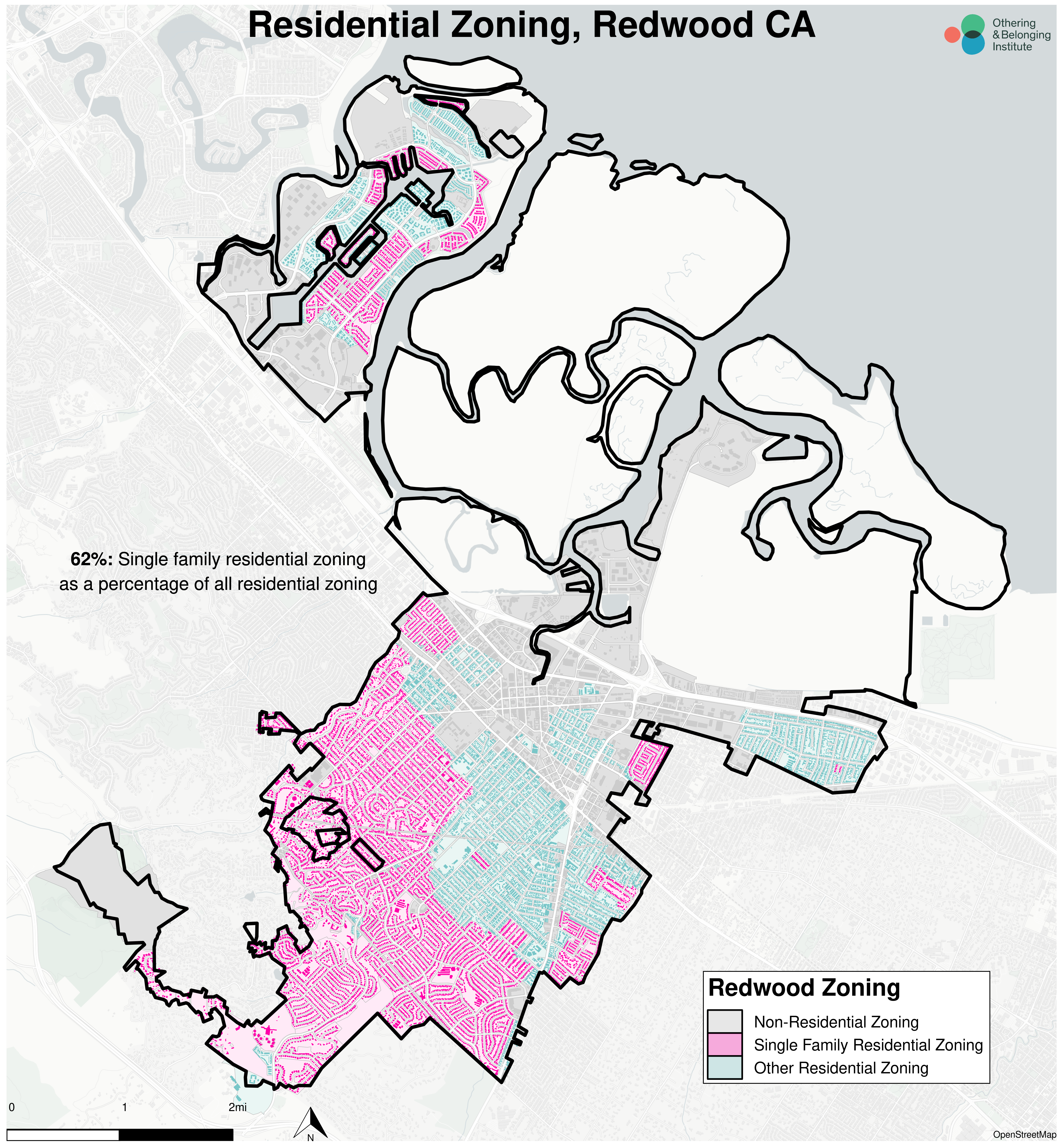
For one, he said, the element does not lay out specific plans to upzone single-family neighborhoods, which currently make up more than 60% of residential land citywide, according to a 2020 study from the UC Berkeley Othering & Belonging Institute. Describing single-family zoning as, essentially, a “ban on affordable homes,” Levine said the city’s failure to take more concrete steps towards increasing density in such high-resource areas constituted a continued acceptance of “exclusionary zoning practices.”
For instance, “there’s no plan to put affordable housing in the most expensive areas up in the hills,” he said.
Exline clarified that no rezonings are included in the housing element, which is exclusively used to outline the “framework and policy” for future housing development. However, rezoning or upzoning certain areas would be considered down the line, she said.
With regards to single-family neighborhoods, Exline said that SB9, which allows cities to convert single-family parcels into higher-density duplexes, “is in essence an upzoning.” She said the city planned to study the efficacy of SB9 so far, encourage the construction of more ADUs and look into other ways of increasing density in high-resource areas.
Levine also criticized the city’s long entitlement processing times that slow the construction of affordable housing and may discourage potential developers from coming to Redwood City. While the new housing element “makes a commitment” to expedite these processes, he said, it lacks specificity.
According to Exline, the planning commission will consider new measures to streamline affordable housing development by April this year as part of a larger discussion about zoning amendments.
Still, Levine said promises were not enough.
“Projects are going to die in Redwood City because staff are not moving them forward,” he said.
Next steps
In March, the city will review the Annual Progress Report for 2022 with updates about progress towards meeting RHNA goals, including how many units have been approved or are now under construction.
The first substantial change will likely be the implementation of zoning changes brought before the planning commission this spring, according to Exline.